Don't build the AI agents your vendor will hand you tomorrow

By Xavier Franco, CEO de Elternativa · Grupo Zemsania
· 6 min read
Written with the help of AI and reviewed by Xavier Franco

In this article
It is a question I hear a lot: "should we build our own AI agents?" I understand the temptation. Everyone is talking about agents, vendors are promising them and nobody wants to be left behind. My answer, for most companies, is no. Or rather, not the way it is usually framed. Let me explain why.
We are in an age of craftspeople
AI has put all of us on the same starting line, and at full speed. Customers, service providers and vendors all began at the same time. The spirit of the early days of computing is back: self-taught people, repositories and publications that solve part of the problem. I think that is great.
But a company cannot live on craftsmanship. The challenge for any organisation is to bring all of that in-house with security, with architecture and with governance. And that is where many agent projects go wrong.
Gartner put numbers on it in June 2025: it predicts that over 40% of agentic AI projects will be cancelled by the end of 2027, because of soaring costs, unclear business value or inadequate risk controls. It also warned about "agent washing", the same old products rebranded as agents, and estimated that only about 130 of the thousands of vendors claiming to sell agentic AI actually do.
In practice: list the agent projects you have under way and, next to each one, the business value it has to prove and by when. If you cannot write it down, it is a candidate for that statistic.
Why your agent ages from day one
OpenAI, Anthropic, Google or Microsoft release new capabilities at a frantic pace. What you build today with great effort on top of their API may come built into their product tomorrow. Building your own agents on top of APIs is obsolete from minute one.
This is not a criticism of those who try. It is a question of where you put your investment. Keeping pace with every vendor, across every technology, is an enormous effort that no company can sustain at this speed. And it does not have to.
An insurer should focus on serving its customers better and getting more out of its policies. Not on competing with AI labs.
In practice: before approving an in-house agent, ask what will happen to it when the vendor ships that same capability. If the answer is "we'll throw it away", think about whether it is worth it.
Where the value is: adopt, orchestrate and govern
If it is not in building, where is the value? For me, in four verbs:
- Adopt the best of the market, without tying yourself to a single vendor.
- Orchestrate those AIs so they work as a team, with a common method, in parallel and with tasks that can be verified.
- Govern what they do: what was asked, who did it, who validated it and what it cost.
- Modularise, so you can swap one piece when something better comes along without redoing everything else.
It is the age-old symbiosis between customer and integrator. The AI vendor lets you connect; making all of that work inside your company, with your systems and your rules, is a different job. We take it on as our own: we are integrators, and today the job is integrating AI.
In practice: take stock of the AI you already pay for (Copilot, ChatGPT, Claude, Gemini…) and ask yourself how much real performance you get out of it. Often the best agent is the one you already have, well orchestrated.
What happens when you orchestrate it
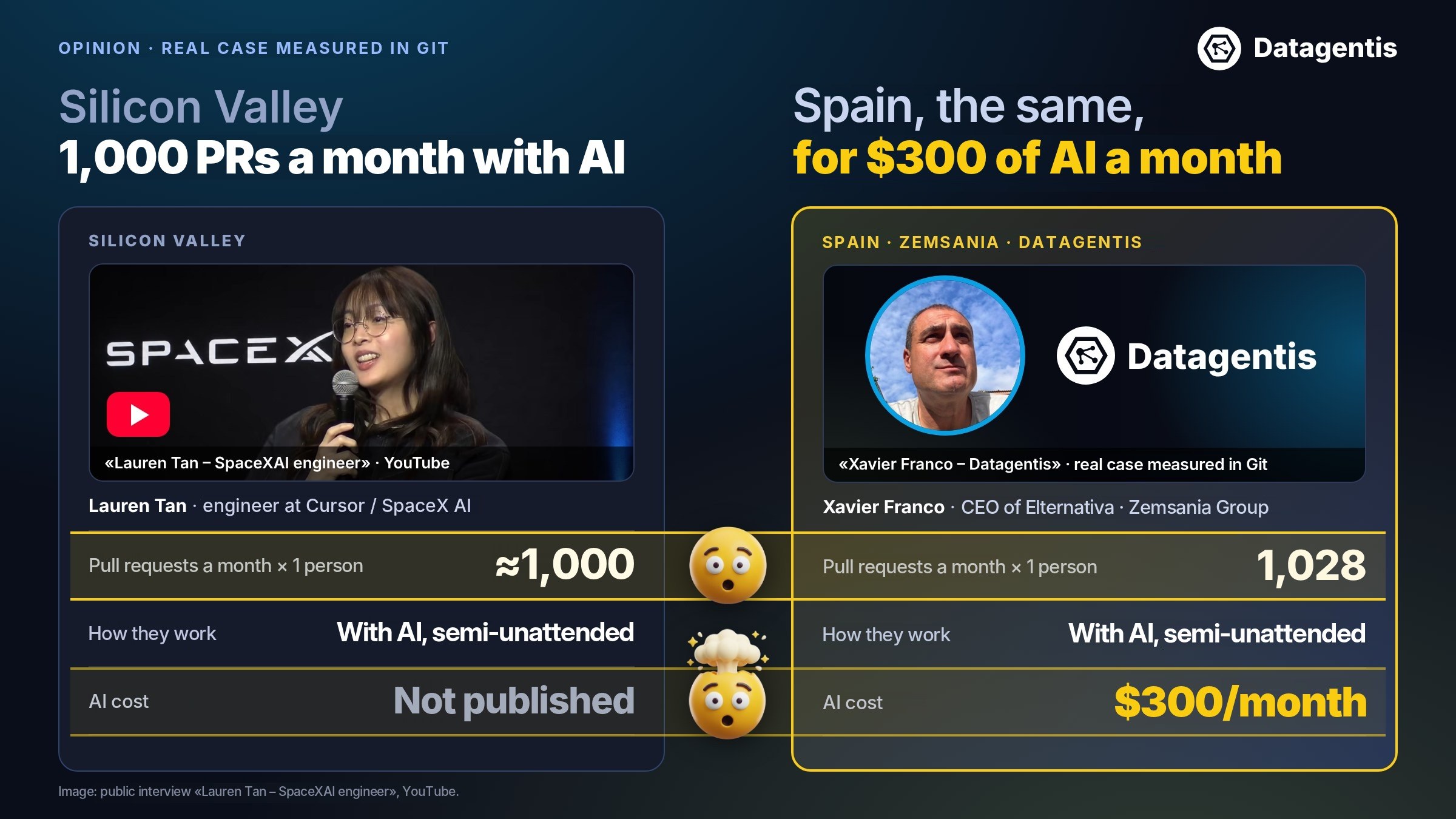
Let me give you the example I know best, software development. AI is already in the teams, but this way it does not scale: a person asks the AI for something and waits, reviews it and asks again. When you orchestrate those same tools, the picture changes:
- several AI instances work in parallel, each with its own role (build, test or validate), without getting in each other's way;
- every task is born with its criteria and a different instance tests it;
- a person decides, and nothing moves forward without their approval;
- the knowledge stays in-house, in a database of your own, and not in the memory of a conversation.
You have not built a single new agent. You have made the ones you were already paying for work as a team.
How to tell a real agent from "agent washing"
I do not want this to be read as a "no" to agents. Gartner, in the same forecast, estimates that by 2028 at least 15% of day-to-day work decisions will be made autonomously through agentic AI, up from 0% in 2024, and that a third of enterprise software will include it. Agents are going to be everywhere. The question is which ones are worth it.
When a vendor offers you an agent, I would ask them five questions:
- What does it decide on its own and what does it ask me? If there are no decisions of its own, it is an assistant under another name.
- How do I know what it has done? Without readable traces, there is no way to govern it.
- How much does each run cost? Model consumption grows fast if nobody sets limits.
- What happens when it gets it wrong? A person must validate what matters.
- Does it work with the AI I already have? If it forces you to switch model or platform, you are buying a tether.
If the answers are not clear, you are probably looking at agent washing: an old product presented as something new.
In practice: put those five questions to the AI vendors on your table this quarter. The answers will tell you whom it is worth spending time on.
Where to start
- Review your agent projects against their business value. For those that cannot show it, consider stopping them.
- Take stock of the AI you already pay for and who uses it.
- Pick a repeatable process, such as application evolution or testing, and orchestrate the AI you already have there.
- Put method before tool: criteria before starting, independent tests and a person who validates.
- Measure on your own data and decide whether to scale.
And one more thing: the pace is frantic, but your team does not have to chase it. Let it be absorbed by those whose job it is.
How we help
In Agentic Data & Software Engineering we orchestrate the development AIs you already have under contract, such as Claude Code, Cursor, Codex or Copilot, so they work in parallel, unattended and governed, across the whole software development lifecycle. The code stays in your Git and the knowledge in a database of your own.
We do it with Agentagile, our methodology: we do not create new agents, we turn the AI you already have into a team that works with method. Your AI develops, tests and documents; your team decides.
How much have you invested in agents your vendor already includes?
In a demo, we show you how we put the AI you already pay for to work, orchestrated, traced and governed, without building new agents.