Silicon Valley merges 1,000 pull requests a month with AI. So do we, from Spain and for $300 of AI a month

By Xavier Franco, CEO de Elternativa · Grupo Zemsania
· · 7 min read
Written with the help of AI and reviewed by Xavier Franco
In this article
- What is being published from Silicon Valley
- Spain: 1,028 pull requests in 30 days
- How it started: a platform that builds itself
- The secret: the method lives inside the system
- ×2: the smart fleet
- ×4: smart validation
- 29 cents per pull request
- From this week, the whole team
- What this means for your company
- How we help
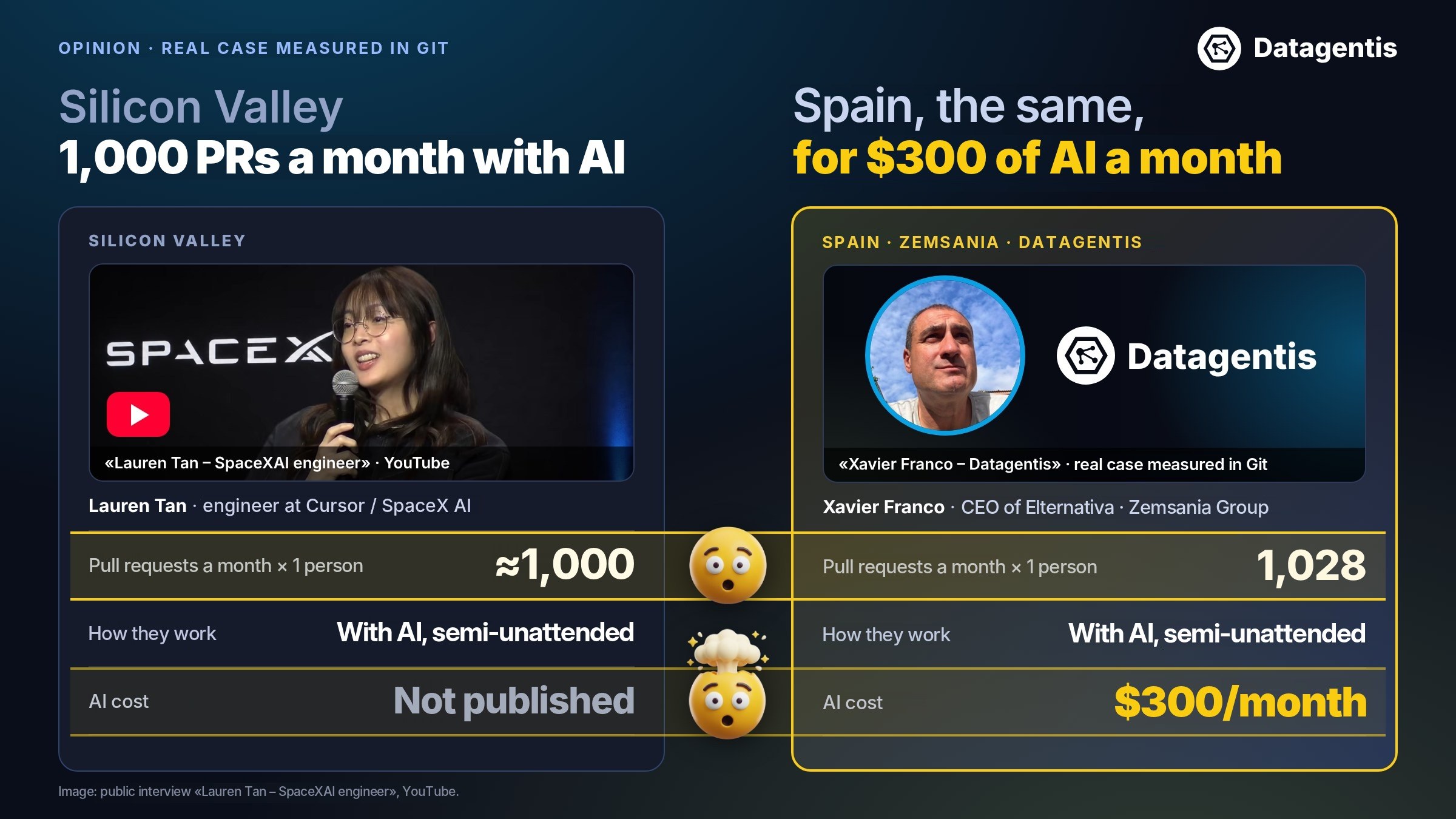
An engineer in Silicon Valley has gone viral for merging 1,000 pull requests a month working with AI. It is shared as the latest and greatest. At Datagentis we do the same. From Spain. With a single person. And with $300 of AI a month. I won't just tell you: I'll show you, with the charts from our own Git. This is a test I ran myself, personally, over 30 days, and that is why I sign it.
What is being published from Silicon Valley
The engineer is Lauren Tan, and she is no ordinary one:
- She is part of the React team, one of the most widely used web interface libraries.
- She opened the React Conf 2024 keynote while working at Meta.
- Today she works at Cursor, one of the best-known AI code editors, based in San Francisco and recently bought by SpaceX. That is why she is introduced as an engineer at SpaceX AI.

Public interview on YouTube: «Lauren Tan - SpaceXAI engineer». Watch the interview on YouTube →
In her interview she says that last month she sent about 1,000 pull requests, and in another version of the talk she mentions 2,000. Her secret is not having fifty agents: she herself says she works with two or three at a time. Her secret is that she doesn't need to watch them, because she has built a system that checks the work before it reaches her:
- Verification: the agent tests its own work the way a user would.
- Evaluation: other agents evaluate that work against fixed criteria.
- Rules that are never skipped: what a person corrects twice becomes a rule.
Her line sums it up: trust first, then parallelism.
Spain: 1,028 pull requests in 30 days
Now, the data from my test. From 16 October to 16 November 2026, measured in the Datagentis Management Center:
How they are organized: each Claude Code account has its own fleet, each fleet groups that account's instances, and all the fleets form a pool that the platform governs on its own.
The same pace the Silicon Valley references publish, and with the cost in plain sight: $300 of AI a month.
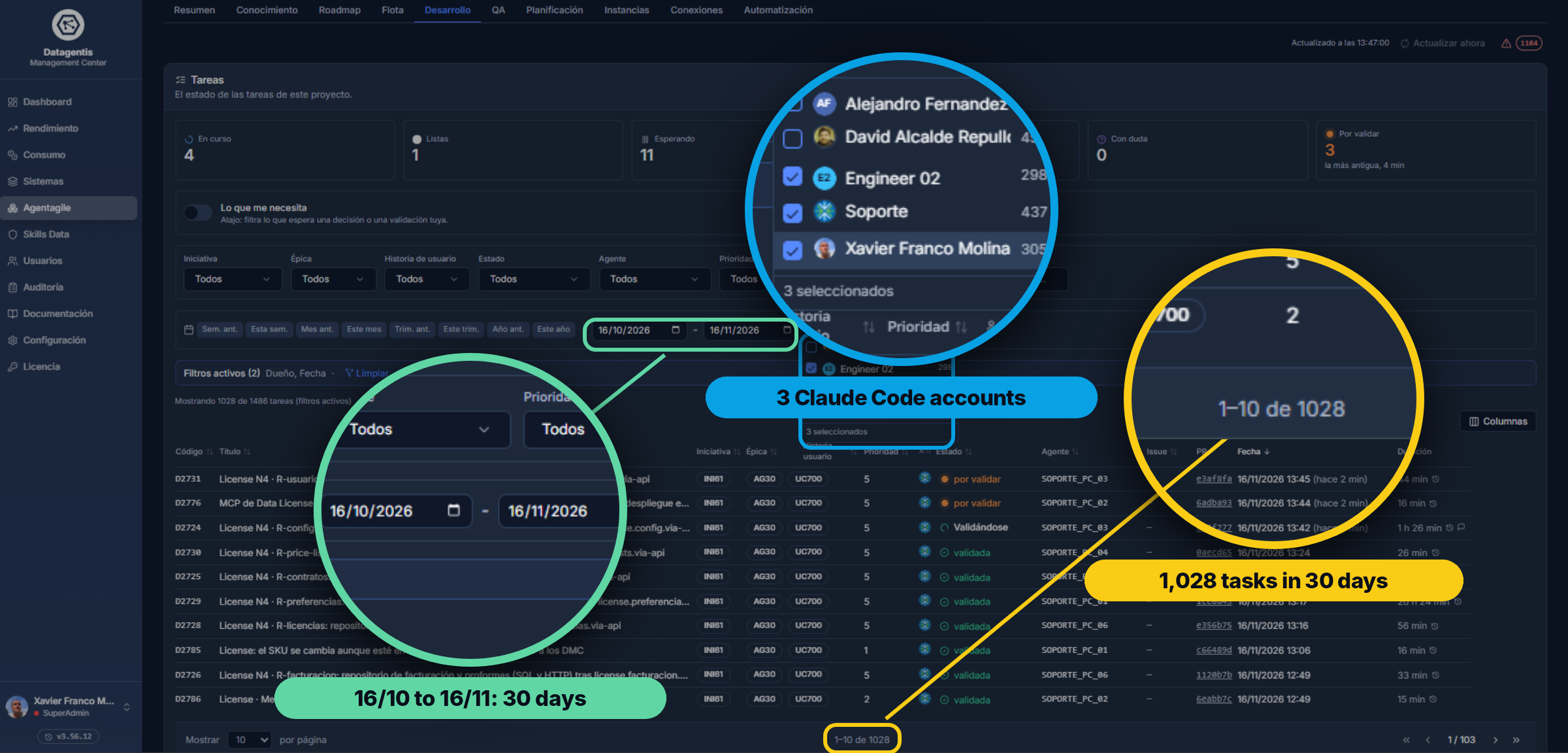
Original screenshot of the Datagentis Management Center: my queue for the last 30 days, filtered by my 3 accounts. 1,028 tasks, each with its instance, its pull request and its status. Those marked «Validating» or «awaiting validation» have been waiting minutes, not days.
How it started: a platform that builds itself
The most powerful thing about this case is that the platform we use to develop is the same one we are developing. Datagentis and its methodology, Agentagile, are built with Datagentis and Agentagile.
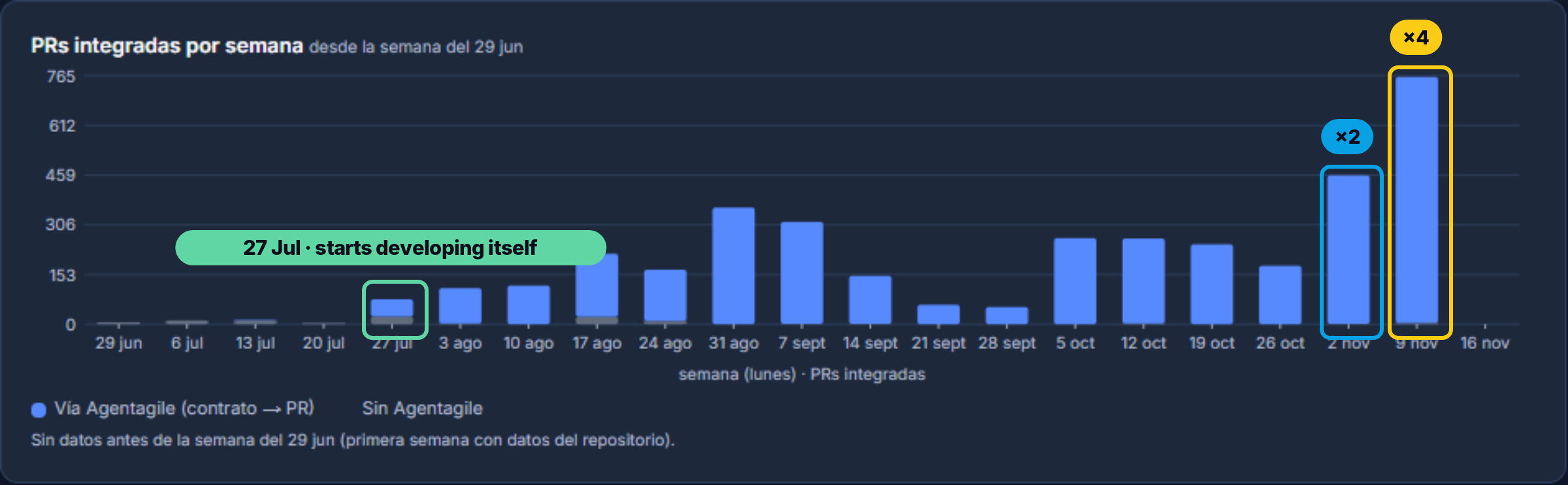
Original chart from the Performance panel: PRs merged per week in our GitHub repository. In blue, those that come in through Agentagile (contract → pull request). Marked: 27 July and the last two weeks.
Look at the chart with me:
- 27 July: the platform starts developing itself. From then on, almost everything that gets merged comes in through Agentagile.
- August and September: hundreds of pull requests a week, with peaks of over 350.
- October: cruising speed, between 180 and 260 a week. Already a pace few teams reach.
- The last two weeks: this is where everything takes off, with two new features. The smart fleet, the week of 2 November (×2), and smart validation, the week of 9 November (×4). I'll explain them now.
The secret: the method lives inside the system
I don't write those pull requests. I don't chase any AI. There are 38 Claude Code instances, each with its own clone of the code, spread across the fleets of the three accounts. The platform governs the pool on its own, with 24/7 working capacity. Everything runs in semi-unattended mode, just like Lauren Tan's: I set the direction of the product, what gets built and when it is done right, and the system builds, tests and validates. I step in to decide, not to watch.
It works because the method isn't in anyone's head. It is inside the system:
- Harnesses: every task is born with its contract, its criteria and its tests.
- Guardrails: the project's rules are served to every instance on every task.
- Memory: every mistake becomes a rule, and the next instance no longer repeats it.
The system already knows how to build, how to test and how to validate. The only thing that isn't delegated is knowing where the product is going. It is Lauren Tan's thesis taken to the extreme: when you trust the system, one person is enough to move an entire fleet.
×2: the smart fleet
On 2 November we switched on the smart fleet. Development instances stop being loose sessions and become a fleet the platform governs:
- It assigns each task to an instance and orders it to run it, in a clean session.
- It spreads the work according to each Claude Code account's quota: none runs out too early, none sits idle.
- It recovers on its own if an instance gets stuck or goes down.
×4: smart validation
Once production doubled, the bottleneck became validating. So the week of 9 November we switched on smart validation:
- The same plan that distributes development also distributes validation.
- A validator instance reads the code of each pull request and checks it against the contract's criteria and tests.
- No instance validates what it programmed itself.
- What is rejected goes back to the queue with its reason; what is validated is ready for the final decision.
And on the performance panel for the whole team in 2026: 78.2 PRs per week per person, ×9.8 against our own history and ×20.6 against the industry benchmark.
To give you a sense of scale: the most cited study on GitHub Copilot, with 4,867 developers, measured 26% more productivity with AI. We aren't talking about percentages. We are talking about multiplying.
29 cents per pull request
You don't need a Silicon Valley budget to work at their pace. You need method built into the system. And that is exactly what we have built.
From this week, the whole team
I ran this test myself, with my three accounts and my own work queue, so that I could tell it with data and sign it. Now it is time to scale it: from this week, our whole team works this way, each person with their own fleet, the smart fleet and smart validation.
If a single person has reached 1,028 pull requests in 30 days, the escalation in functionality we are about to deliver is going to be impressive. I will keep telling you about it here, with the data from Git.
What this means for your company
If one person with $300 a month merges more than a thousand pull requests, the question is no longer whether AI can speed up your development. The question is how long you will keep not doing it.
Where to start:
- Measure your starting point: pull requests merged per week per person.
- Put the method into the system, not into people's heads.
- Separate whoever executes from whoever validates, among AI instances too.
- Organise the instances as a fleet and distribute them according to your accounts' quota.
- Compare it on your repository, in a limited scope, before scaling.
How we help
At Datagentis we don't build agents: we use your AI, the one you already have under contract, and we orchestrate it. We give it a common method that you define, so it develops the way your organisation would, and your team focuses on what truly adds value: defining use cases and deciding. It is the same methodology, Agentagile, that we use to build Datagentis.
There are three ways to work with us:
- We advise you: diagnosis and a phased roadmap.
- We do it for you: we run your projects with our system, under the arrangement you already buy: technical assistance, fixed-scope project or managed service.
- Hybrid Technical Office: we help you set up your own, operated by your teams and your suppliers.
We start with a pilot, and you decide with your own numbers.
What if your team delivered four times more with the same people?
We show you the fleet and the validation working live, and how we measure the jump on your own repository.